



A number of people have asked me recently for book recommendations on embodiment, somatic psychotherapy, body awareness, and some of the older body-based lineages that are not organized around the newer clinical vocabulary of trauma, nervous-system regulation, or polyvagal-informed care.
It is a harder list to make than it might seem, not because there are too few books, but because embodiment is not really something that can be transmitted by books. A book can orient us. It can give language to something we have been sensing. It can clarify a principle or reorganize the way we perceive. But the work itself always returns to direct experience: sensation, movement, contact, pressure, pattern, rhythm, posture, action, and the way a life is taking form in the present moment.
A lot of contemporary embodiment language has become quite narrow. The body is often discussed as a nervous system to regulate, a trauma response to track, or a place where symptoms are stored, hidden, released, or discharged. I do not mean that dismissively. Those frames can be useful, and sometimes very useful. But they are not the whole field. The body is also where meaning begins before it becomes language, where relationship is organized before it becomes story, where memory emerges from posture and gesture, and where the personal, biological, social, and symbolic continuously shape one another.
So this is not a neutral bibliography, and it is not a clean “best somatic books” list. A small number of these books are accessible enough for thoughtful clients or lay readers. Most are more useful for therapists, consultants, and people who work directly with human process. A few are really for practitioners with enough embodied experience to want something more dynamic than a prescriptive model or set of techniques.
The books that have mattered most to me did not simply give me information. They changed how I discern and value different kinds of information.
I was, and in many ways still am, a very mentally and conceptually organized person. I like the feeling of a cranium full of energy and ideas. I like thinking about life’s questions, turning them around, building connections, and following ideas into larger patterns. Thinking has value; I have no interest in pretending otherwise. But much of my development as a practitioner has involved cultivating a long relationship with my own embodied patterns: the ways I shape myself, organize contact, extend, compress, reach, contract, and form experience in real time.
And then there is the immense blessing of working with thousands of people in their personal and professional contexts, learning the distinct ways they form themselves too. Not as conceptualizations, not only as histories or diagnoses or narratives, but as living patterns of movement, attention, emotion, contact, and action.
These are some of the books that helped me understand all of this more clearly.
Subscribe for a weekly synthesis of research on mind, body, and collective behavior.
Alan Fogel, Body Sense
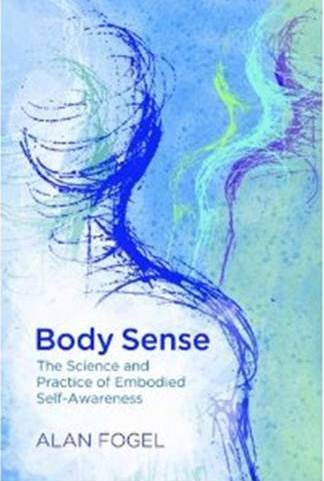
Alan Fogel’s Body Sense: The Science and Practice of Embodied Self-Awareness is one of the most accessible books on this list, and probably the best bridge for readers who are curious about embodiment but do not want something either overly technical or overly simplified.
For me, this was one of the first books that gave a contemporary frame for a kind of knowing I was already trying to notice clinically: a way of knowing that was not primarily analytical, conceptual, or thought-driven. Fogel’s distinction between a conceptual self-awareness and an embodied self-awareness gave me language for this distinction.
There is the self from which we can explain, narrate, improve, defend, and analyze. And then there is the self we sense from the inside. Fogel is interested in that second mode of self-contact: present-moment bodily sensing, interoception, proprioception, autonomic shifts, feeling, movement, breath, voice, boundaries, safety, and social engagement.
The book’s strength is that it treats embodied awareness not as a decorative supplement to insight, but as its own mode of intelligence. It does not collapse embodiment into a few nervous-system diagrams or a set of calming exercises. It gives a broader developmental and clinical frame for why sensing the body matters, and why that sensing is not secondary to psychological understanding.
I would recommend Body Sense to practitioners who want a solid, readable, clinically relevant introduction to embodied self-awareness. I would also recommend it to many clients, especially those who are curious, psychologically minded, and not looking for a quick self-help protocol. It is not a workbook, and it is not especially narrow, but as a bridge between clinical language and lived bodily experience, it is very good.
Dick Price and Gestalt Practice

Dick Price is a different kind of recommendation because the available book material is reconstructed from a practice lineage rather than written as a conventional clinical text. I include it because Gestalt Practice represents something foundational in how I understand awareness, emergence, and the formation of experience in the present moment.
The core lesson of Gestalt, for me, is phenomenological attention. Gestalt asks us to notice how experience is forming right now: what becomes figure, what recedes into ground, what is interrupted, what is avoided, what is being contacted, what is exaggerated, and what is trying to emerge.
That kind of attention is not passive. Attention organizes experience. It changes the subjective field. Something that had been operating outside of awareness can become clearer when it is noticed with precision and allowed to develop. A gesture, a posture, a phrase, a tightening, a shift in tone, a way of looking away, or a repeated movement can become the doorway into the pattern itself.
Gestalt Practice does not begin by explaining experience from the outside. It asks what is happening, how it is happening, and what the phenomenological detail of the moment actually is. What happens if the person stays with it, repeats it, exaggerates it, gives it voice, or lets it become more fully known?
In that sense, Gestalt invites the pattern of habit to reveal itself. The point is not to interpret the pattern too quickly or replace it with a better idea. The point is to let the person experience the organization directly enough that the pattern becomes available to awareness.
This is also where I see a natural bridge to Keleman. Gestalt helps bring the pattern into awareness as an emergent organization in the field. Formative Psychology® then gives a more explicit somatic method for working with the pattern itself: how it is made, how it is maintained, how it can be intensified, interrupted, paused, and practiced into a new form.
I would recommend this text to practitioners interested in the phenomenological roots of embodied work, especially those who want to understand awareness as an active process in how experience forms. It is not a standard psychotherapy manual. It is a doorway into a way of attending to experience as it emerges.
Stanley Keleman, Embodying Experience
![Embodying Experience: Forming a Personal Life] [Author: Keleman, Stanley] [December, 1987]: Stanley Keleman: Amazon.com: Books](https://substackcdn.com/image/fetch/$s_!hmX-!,f_auto,q_auto:good,fl_progressive:steep/https%3A%2F%2Fsubstack-post-media.s3.amazonaws.com%2Fpublic%2Fimages%2F2fa2a77a-1d0e-43d1-9802-d0c4f79f9977_768x1000.jpeg "Embodying Experience: Forming a Personal Life] [Author: Keleman, Stanley] [December, 1987]: Stanley Keleman: Amazon.com: Books")
If Gestalt helps reveal the pattern as it emerges, Keleman’s Embodying Experience offers a method for working with how that pattern is forming in real time.
This is the book where Keleman describes his HOW methodology. The process is not a technique in the ordinary self-help sense. It is not a release exercise, not a cathartic method, and not a way to perform authenticity. It is a methodology for engaging and influencing experience as it is happening.
That is the essential shift. Much of psychotherapy asks why something is happening. Keleman asks how it is happening.
How am I using myself to make this experience? How do I tighten, collapse, lift, brace, reach, shrink, hold, inflate, or numb? How do I create the bodily-emotional form that I then call anxiety, certainty, shame, longing, resentment, helplessness, control, or love?
This is what I find so important in Embodying Experience. It gives a template for working with dynamic experience in the present moment, not only by talking about it or thinking about it, but by entering the formative process itself. Keleman is interested in how images, muscular patterns, emotional attitudes, social forms, and personal history are organized through the way a person shapes themselves.
The HOW process asks a person to identify the situation or self-image, discover how the body is making that form, intensify or vary the pattern, stop or disorganize it, wait in the pause, and then practice a new response.
I would recommend Embodying Experience mostly to practitioners, especially those who already have some somatic or experiential background. It is short and spare, but it contains a genuine method. It does not explain everything. It gives you something to practice.
Stanley Keleman, Emotional Anatomy
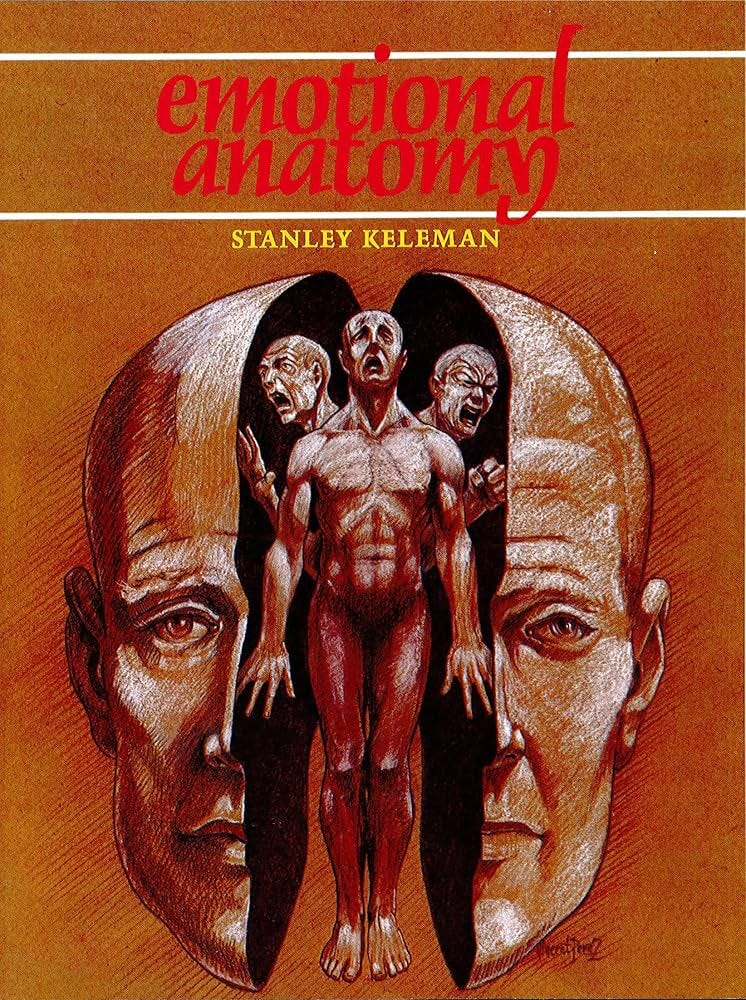
If Embodying Experience gives a method for self-engagement, Emotional Anatomy offers a deeper perceptual invitation.
Many people consider Emotional Anatomy to be Keleman’s seminal work. I do too, though not because I understood it quickly. It took me years to begin to understand what he was writing about. Keleman asks readers to perceive their own formative experience.
Not something hidden in the body. Not as a feeling that “shows up” somewhere in the body. Not the body as a surface on which psychological meaning appears. Something more radical than that. Keleman is saying that body morphology is what structures experience directly.
His phrase “Life makes shapes” sounds simple, but it is not simple at all. A person’s history is not only in their story. It is in their musculature, posture, pressure, containment, collapse, rigidity, inhibition, gesture, timing, and capacity for expansion and contraction. A feeling is not merely an amorphous internal state. It has a physical architecture.
This is why Emotional Anatomy was not, for me, a book I could simply read and understand. I had to grow into it experientially over years. It became more intelligible through more than a decade of working with formative principles, including direct experience with Stanley himself and with his senior students. The book began to make clear sense as soon as my own perception changed.
That is also why I would not recommend it to most clients. I would not even recommend it as a first Keleman book for many clinicians. It can be read and understood conceptually, but even then something essential is missed. The book is not just offering ideas about the body. It is trying to point to direct experience.
You do not have to agree with every claim in the book to be changed by the level at which Keleman is looking. That is part of its value. It does not simply add information. It challenges the perceptual habits of the reader.
Stanley Keleman, Bonding
Bonding: A Somatic-Emotional Approach to Transference may be one of the most clinically interesting and least casually recommendable books on this list.
This book has influenced how I think about emotional dynamics in relationships and groups, probably more than I originally realized. Keleman’s organizing principle here is that relationship is not separate from biological process. The ways we bond, separate, fuse, withdraw, demand, resist, long, collapse, control, attach, differentiate, and refuse contact are not only psychological themes. They have forms that follow biological trajectories.
This is what makes the book so useful for clinicians who care about transference, countertransference, and the relational field. Keleman is not only asking what a client wants from the therapist, or which early relationship is being repeated. He is asking how a person uses themself to bond, separate, seek contact, defend against contact, control closeness, or maintain distance.
That is a very different way of thinking about transference. The body is not just what the client brings into the room. It is the engine of what happens between therapist and client. The therapist’s body participates not as a neutral instrument, but directly in the field of somatic and emotional exchange.
For me, this extends far beyond the therapy dyad. It has shaped how I think about couples, families, groups, institutions, and collective behavior. Again and again, what we see “out in the world” can be understood as analogous to the biological systems we are made from: expansion and contraction, permeability and boundary, fusion and differentiation, nourishment and refusal, pressure and release, contact and withdrawal.
That does not mean reducing social life to biology. It means recognizing that biological form and relational form are not separate. The systems we create often seem to repeat the organizing principles we are made from.
Keleman’s idea that contact, closeness, and distance serve a function has stayed with me. It refuses to reduce relationship to preference, attachment style, story, or pathology. Distance may be functional. Fusion may be functional. Refusal may be functional. Longing may be functional. The question becomes: what form is being sustained, protected, repeated, or developed through this pattern of contact?
I would recommend Bonding only to experienced clinicians, especially those with psychodynamic, psychoanalytic, relational, Gestalt, or body psychotherapy backgrounds. It is specialized and does not speak in the newer dialects many people expect. But for therapists who want embodiment brought into the relational density of psychotherapy rather than treated as a separate intervention track, it is one of Keleman’s most important books.
The Handbook of Body Psychotherapy and Somatic Psychology
This is not a book I would suggest reading straight through unless you are unusually determined.
The Handbook of Body Psychotherapy and Somatic Psychology is enormous, heterogeneous, and uneven in the way serious field-wide handbooks tend to be. Some parts feel dated now. Some sections belong very clearly to earlier conversations in the field. But I still think it is one of the most thorough and useful maps of body psychotherapy available.
Part of its value is that it is decentered from the more recent American-born models of trauma, nervous-system regulation, and therapeutic branding. Those models can be useful, but they are not the whole history of somatic work. Sometimes they make the field feel much narrower and more recent than it actually is.
The Handbook restores scale. It brings forward psychoanalytic, Reichian, post-Reichian, Gestalt, developmental, phenomenological, movement-based, relational, energetic, and European body psychotherapy lineages that often disappear in contemporary discussions. It reminds us that the current conversation did not begin with trauma-informed care, and embodiment is not reducible to regulation.
For practitioners, that matters. Without a broader map, it is easy to mistake the most marketable version of somatic work for the field itself. The Handbook makes that harder to do. It shows body psychotherapy as a long, contested, diverse, and intellectually serious field with many different theories of change, different clinical traditions, different relationships to touch and movement, and different understandings of the body-mind problem.
I would not give this book to a client. I would not give it to someone looking for a gentle introduction. I would give it to a practitioner, trainer, supervisor, consultant, or institute library. It is the kind of book one consults rather than consumes.
Its presence on this list says: this field is older, wider, stranger, and more philosophically complex than the current therapeutic marketplace often shows.
#research | #theory | #practice

About emotive.energy
We study how people think, feel, and respond in real time, and how those patterns interact in groups and systems. As a research-led co-op and working laboratory, we help individuals, teams, and organizations recognize and shift the dynamics that shape experience, including stress, decision-making, relationships, creativity, and meaning. Our work spans contexts from workplaces and leadership to family systems, artistic practice, and personal development. Through coaching, group programs, and proprietary tools, we make these dynamics visible as they form so people can work with them directly. The result is clearer thinking, more effective action, and more adaptive ways of relating under pressure and in everyday life. [website]
Links
Website: emotive.energy
Substack: Posts · Notes · Podcast
Social: Twitter / X · BlueSky · YouTube · Facebook · LinkedIn · Instagram
Podcast: Apple Podcasts · Spotify · Pocket Casts · Overcast
i am constantly drawn in by the over-proceduralised somatic approaches (due to my own anxiety and desire to be ‘useful’ as a therapist). Yet I know that the relation and emergent embodiment of the gestalt way holds more potency and potential for genuine awareness and change. Thank you so much for sharing these resources, many of which are now on their way to me!
Thanks for the interesting book recommendations and the thoughtful and thorough descriptions of each. I trust your recommendations as an experienced practitioner, a spiritual seeker and a deep thinker (and feeler).